

What if the strongest proof of funds isn’t the biggest bank balance, but a clear explanation of where the money comes from and how it will support your studies? If you’re preparing proof of funds for student visa India applications, you may be unsure which documents to gather, whose money can count, or whether savings, a scholarship, or an education loan fits the rules.
Requirements vary by destination, so a checklist from another applicant may not suit your visa application. This guide explains how to identify potential funding sources, connect them to supporting evidence, and check the latest requirements with the official immigration guidance for your destination. You’ll also learn how to organise your records and spot details that may need clarification before you apply. StudyFynder can guide you through visa document preparation as part of your study-abroad application process. The aim is to prepare a clear, consistent file without assuming that a particular document or funding source will be accepted everywhere.
Key Takeaways
- Distinguish the funds available for your studies from the documents that show their source and access.
- Assess possible evidence, including bank records, scholarship letters, and loan documents, against your destination’s rules.
- Check the proof of funds for student visa India requirements that apply to your destination, rather than relying on a universal threshold.
- Look for details that may need explanation, such as unclear deposits, names that don’t match, or missing supporting records.
- Build a consistent evidence file by confirming current official guidance, mapping your funding, and reviewing your documents before submission.
What does proof of funds for a student visa from India mean?
If you’re applying from India to study overseas, proof of funds is evidence that you can meet the study and living costs relevant to your destination and circumstances. The required amount, eligible funding sources, accepted documents, and evidence timing vary by country and can change. Check current government instructions before preparing your application.
Keep two things distinct: funds are the financial resources available to support your studies; financial documents are evidence of those resources, their source, and, where required, access to them. Proof of funds is not necessarily proof of payment. A tuition receipt shows that a payment has been made, while financial evidence may be requested to show how other applicable expenses will be covered. What counts depends on the destination’s rules.
Why student visa authorities ask for financial evidence
Financial evidence helps visa authorities assess how your study-related expenses are expected to be covered. This is separate from university admission: an offer of a place does not itself establish that you meet a visa’s financial requirements. It is also different from paying tuition to your institution. Even a well-organised file cannot guarantee a visa decision, because the authority assesses the application under its current rules.
Which requirements depend on your study destination?
Before gathering documents, confirm four details in the official instructions for your destination:
- Amount: which expenses must be covered and how the required amount is assessed.
- Eligible funding: which sources, such as personal funds or support from another person, may be considered.
- Accepted evidence: which documents can demonstrate the funds and their source.
- Evidence timing: whether the instructions specify how recent or long-running the evidence must be.
Use country-specific guidance, not a checklist copied from another applicant. For example, UK applicants should consult UKVI’s Student visa financial requirements; applicants to Canada should check the Government of Canada’s study permit financial support guidance; and applicants to the United States should refer to the U.S. Department of State’s student visa information. These are separate systems, not interchangeable rules. The phrase proof of funds for student visa India describes preparation by an applicant in India. It does not mean every destination uses the same financial test.
Start by identifying your destination and visa category, then read the relevant government instructions closely. StudyFynder can help you organise visa documentation, while final requirements should always be confirmed with the official authority.
Which funds and documents can Indian students prepare?
List the funding sources you expect to use, then identify records that may help explain each one. Depending on your circumstances, these might include personal bank records, a scholarship award letter, sponsor financial documents, or education loan documents. These are examples to investigate, not a universal checklist. Accepted proof depends on the destination’s current official instructions. Check those instructions before relying on any particular funding source or document.
A clear file should help a reviewer understand who owns or provides the funds, where they come from, whether they’re available, and how they relate to your study costs. If several sources contribute, list each separately and connect it to the relevant supporting records. For example, show which part of your funding plan relies on personal savings and which part relies on a scholarship or sponsor. The right evidence for proof of funds for student visa India applications depends on the rules of the country where you plan to study, not simply on where you’re applying from.
How to document savings, sponsors, and scholarships
For personal savings, check which account records are requested and whether they must show the account holder’s details. If a parent or another person will contribute, confirm whether the destination accepts that type of sponsorship. Its guidance may specify a statement from the sponsor, financial records, or other supporting documents. Don’t assume a bank statement alone explains who owns the funds or how they will support you.
For a scholarship, review the award letter against the destination’s requirements. Check whether it identifies you and confirms the funding amount, what costs it covers, and the relevant study period. If the award covers only part of the expenses considered by the visa authority, identify how you’ll document the remaining funding under that destination’s rules.
How to present an education loan as funding evidence
A loan sanction or approval document may be relevant only if the destination’s current rules accept education loans as evidence. Check exactly what the document needs to show. Official instructions may address whether approved funds, disbursement terms, or other details must be confirmed, but requirements vary. Don’t assume that a loan application or a general bank letter will meet the rules.
Loan moratorium and repayment terms can help you understand your own funding plan. Treat them as financial context, not as visa requirements unless official guidance says otherwise. StudyFynder can help you organise visa documentation as part of your application preparation, but it doesn’t provide loans. Explore visa document preparation support if you’d like guidance arranging your records.
How do you check whether your proof of funds is sufficient?
There isn’t one financial threshold or evidence period that applies to every student visa. Requirements can depend on the destination, visa route, course, and your circumstances. Tuition, living costs, dependants, scholarships, and fees already paid may be treated differently under different rules. Check the current instructions for your application before deciding what amount to show.
First work out the amount the rules require, then confirm separately that your documents show you can access the funds to meet it. Use these steps to assess your proof of funds for student visa India preparation:
- Identify your destination and visa route. Use the rules for the country and student category you’re applying under.
- Find the current official instructions. Start with the destination’s government immigration or visa website, not an old checklist or another applicant’s file.
- Calculate the applicable requirement. Follow the official method and account for the costs or circumstances it says are relevant.
- Match each need to evidence. Connect each required amount or expense with a funding source and supporting document.
- Review the whole file. Check that the documents agree and that any gaps or unclear details are explained before submission.
Find the current official requirement for your visa route
Read the instructions for your exact destination and student route. Check how they apply to your course and personal circumstances, including whether dependants are part of your application. Note the page’s update date and review it again before applying, since guidance can change. If a detail is unclear, seek clarification through the relevant official channel rather than relying on a general online estimate.
Match each requirement to clear evidence
A simple table can reveal gaps between the costs you need to cover and the documents you plan to submit. Fill it in using the official instructions, rather than assuming every example below will be accepted.
| Financial need or adjustment | Funding source | Supporting evidence to verify |
|---|---|---|
| Tuition or study costs | Personal funds, scholarship, or another accepted source | Relevant account or award records |
| Living costs or other stated expenses | Personal funds or accepted sponsor support | Records showing the funds and their source |
| Fees already paid or scholarship coverage | Payment or scholarship | Receipt or award details, if requested |
Before submitting, compare names, dates, currencies, and amounts across the file. Check that translations follow the destination’s instructions. If ownership is unclear or a deposit needs explanation, identify the relevant supporting records and resolve the gap instead of assuming it will be understood. A funding map makes it easier to see what each document supports.
How can you avoid common proof-of-funds problems?
A high account balance may look reassuring, but the amount alone may not answer every question a visa authority has. The documents may also need to show who owns or provides the funds, where they came from, and whether they’re available for the purpose described. An unexplained deposit, different name spellings, or a missing supporting record can leave gaps that need clarification.
For proof of funds for student visa India applications, treat the final review as a preparation step, not a guarantee of approval. General checks can help make your file easier to follow, but the official instructions determine which evidence, formats, translations, and supporting documents are required for your visa route.
Check consistency across financial documents
Review your records together rather than one at a time. Compare account holder names, sponsor details, dates, amounts, and the explanation of how each funding source relates to you and your studies. If a sponsor’s name appears on the funds, make sure the documents required by your destination explain that person’s role.
If a balance changes sharply or a deposit has no clear explanation in the records, check whether official guidance asks for further evidence. Don’t add documents just because another applicant used them. Instead, clarify gaps with relevant records that the destination accepts. Check translation, certification, and file-format rules against the current official instructions for your application.
Plan around changing rules and application timing
Financial guidance can change, so revisit the official immigration instructions close to submission. A friend’s checklist may relate to a different destination, visa route, course, or set of circumstances. Keep a note of the official source you used and its update date, then confirm that the guidance is still current as you prepare your application.
Use this final review to catch avoidable inconsistencies:
- Do names and sponsor details match across records?
- Can you explain the source and intended use of each funding amount?
- Are any deposits or changes unclear based on the documents provided?
- Have you checked current rules for evidence timing, translation, certification, and format?
- Does each document support a specific part of your funding plan?
These checks can help you prepare a clear, consistent file, but they can’t predict the decision. For help organising your visa documents, explore StudyFynder’s visa documentation support.
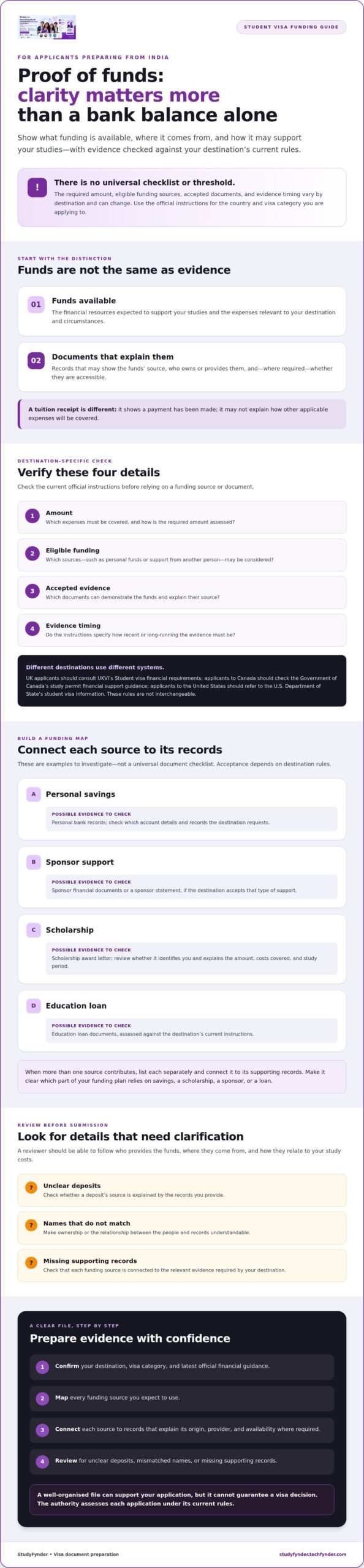
How can Indian students prepare proof of funds with confidence?
A clear preparation routine makes financial evidence easier to organise and review. For proof of funds for student visa India applications, follow the requirements of your intended destination rather than relying on a generic checklist. Your goal is to show how your funding plan connects to the official instructions, not to assume a particular visa outcome.
Build a personal proof-of-funds checklist
Keep a simple record for your application. Note the destination and visa route, save the official guidance you consulted, and record when you checked it. Then list each funding source beside the document you plan to use as evidence. This gives you a practical way to track what’s ready and what still needs attention.
Before finalising your file, mark any unanswered questions. You may need to confirm whether a funding source is accepted or whether a document must follow a specific format. Seek clarification through the destination’s official guidance or relevant authority before submitting. Another student’s checklist is not confirmation that the same evidence will fit your circumstances.
- Confirm: destination, visa route, official source, and date checked.
- Map: each source of funding to the record intended to support it.
- Gather: the documents specified by current official instructions.
- Review: details for gaps, inconsistencies, and unresolved questions.
- Submit: once you’ve checked the complete file against the requirements.
Know when to ask for application guidance
Extra guidance may be useful if your plan combines personal savings, sponsor support, a scholarship, or a loan, or if it’s difficult to show how a document relates to you. StudyFynder supports visa document preparation and study-abroad planning, including organising application materials. This is preparation support, not loan financing or a guarantee of visa approval. Confirm destination-specific rules with official sources.
Your study choice and funding plan are connected, so review them together as you prepare. If you’re still comparing options, explore the 2026 University Selection Guide for Indian Students as a next step. With current requirements, clearly mapped funding, and a careful final review, you can submit a more organised application file.
Prepare your financial evidence with confidence
A strong financial file is more than a balance: it connects your funding sources to clear supporting records. For proof of funds for student visa India, start with the current official requirements for your destination and visa route. Then map each funding source to its evidence, check names and details for consistency, and resolve questions before submitting.
Accepted funds and documents vary, so use official guidance as your reference rather than assuming another student’s checklist applies. StudyFynder offers study-abroad counselling, visa document preparation guidance, and application support from university selection through documentation. This support can help you organise your preparation, but it doesn’t provide funding or guarantee a visa decision.
Ready to organise your next steps? Get guidance with your study-abroad and visa document preparation. Take the process one step at a time, and move forward with a clearer, more consistent application file.
Frequently Asked Questions
What is proof of funds for a student visa?
Proof of funds is evidence that you can meet the study and living costs relevant to your destination and circumstances. The funds are the financial resources available to you; documents such as bank records or scholarship letters help show their source, ownership, and availability. It isn’t necessarily proof that tuition has already been paid. Check the destination’s current official instructions to learn what evidence it accepts.
How much bank balance is required for a student visa from India?
There’s no single bank balance that applies to every student applying from India. The amount depends on the destination’s current rules and may vary with your course, circumstances, and the costs the authority requires you to cover. Check the official immigration guidance for your exact visa route. It should explain how to assess the required amount and whether items such as paid fees or scholarships affect your calculation.
Can I show an education loan as proof of funds for a student visa?
You may be able to use education loan documents if the destination’s current visa rules accept that funding source. Check the official instructions for the type of loan evidence required and what it must confirm, such as approved funds or disbursement details. Don’t assume that a loan application alone is sufficient. Repayment or moratorium terms can help you plan, but don’t treat them as visa requirements unless official guidance says so.
Can my parents sponsor my student visa funds?
Your parents may be able to provide financial support, but sponsor rules differ by destination and visa route. Check whether the authority accepts parent sponsorship and what evidence it asks for. This might include records of the funds and documents explaining the relationship or support arrangement, but requirements aren’t universal. Make sure the sponsor’s name and financial records connect clearly to your application, following the destination’s current official instructions.
Do scholarships count as proof of funds for a student visa?
A scholarship may count toward your financial evidence if the destination’s rules accept it and the award documentation meets its requirements. Check whether the letter identifies you and confirms the funding amount, what costs it covers, and the relevant study period. If the scholarship covers only part of the expenses considered by the visa authority, check how to document the remaining funding before submitting your application.
How recent do bank statements need to be for a student visa?
The required timing for bank statements depends on the destination and visa route. There’s no universal evidence period, so check the current official guidance for how recent the records must be and whether it specifies a particular statement format. Also review account holder names, dates, and amounts for consistency with your other documents. If the instructions are unclear, confirm them with the relevant immigration authority before applying.
Does proof of funds guarantee a student visa approval?
No. Proof of funds is one part of a visa application, and providing financial evidence doesn’t guarantee approval. The visa authority assesses the application under its current requirements, so follow the full official checklist and review every section before submission. A well-organised file can make your financial information easier to understand, but it can’t promise a decision. StudyFynder can guide visa document preparation without guaranteeing visa outcomes.

Article by
StudyFynder
StudyFynder is a study abroad and international education platform that helps students discover universities, courses and study opportunities around the world. It supports international students throughout the study abroad journey, from choosing the right country, university and course to applications, admissions and student visa guidance. StudyFynder provides personalised support for students looking to study in destinations including Ireland, the UK, USA and Canada, helping them understand entry requirements, tuition fees, scholarships, application processes and post-study opportunities.
